
I moved my thumb 1cm and my handstand got better
"Brainy What-Why-How"
Your weekly nibble of science-backed goodness to help you move better and feel unstoppable.
🧠
What (the TL:DR)
I moved my thumb about 1 cm closer to my palm in my handstand and within seconds my press handstand felt easier. My one arm handstand improved too.
Which is ridiculous.
Why should moving a thumb change what my whole body can do?
The answer has very little to do with thumbs:
One joint that isn’t doing its job well can force the rest of the body to compensate -- and this matters more than you may think!
Why (the geeky neurology)
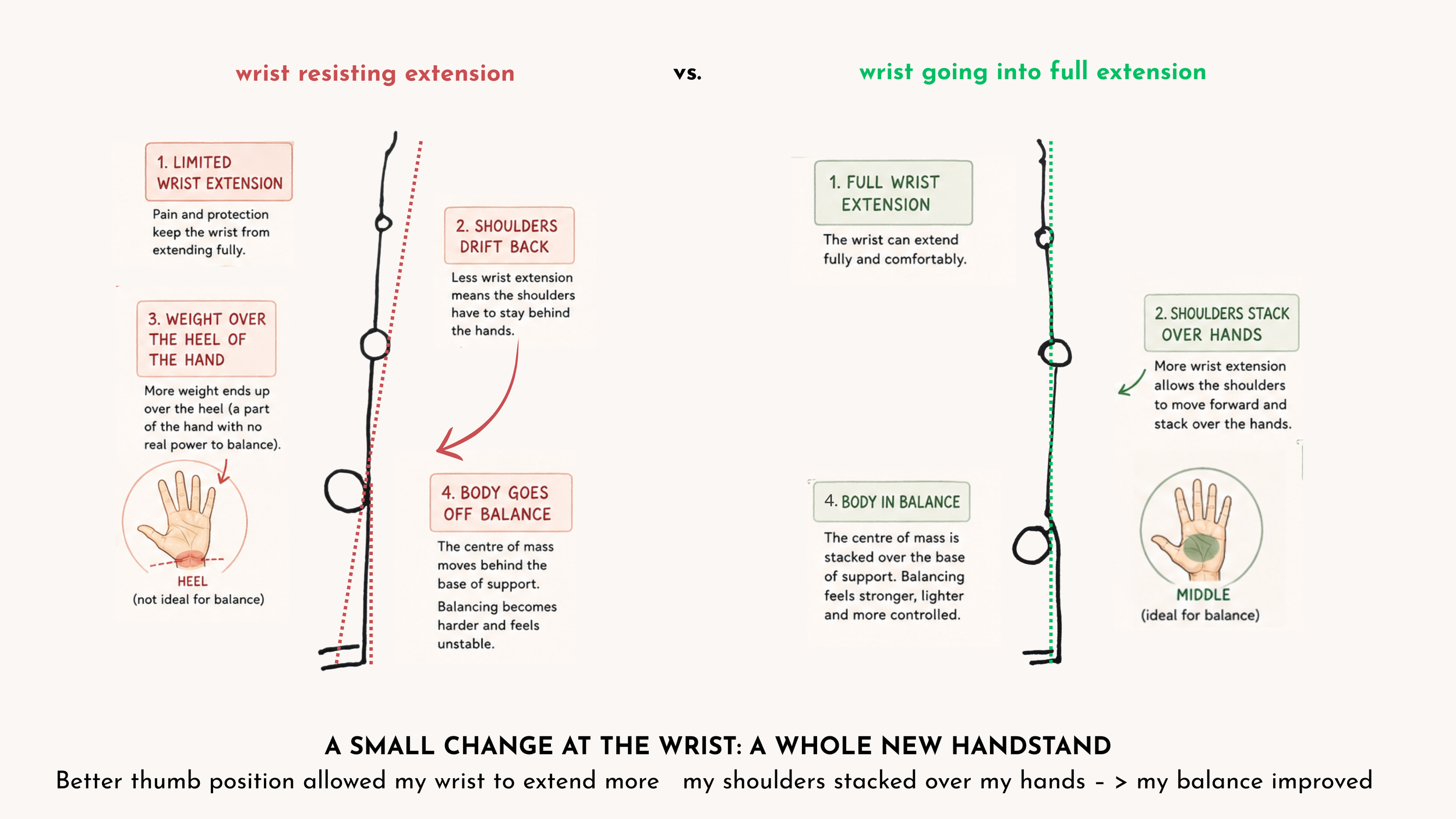
I developed an injury* that meant every time I loaded my wrists in a handstand, my brain quite reasonably tried to protect the painful tendon.
The result was that I stopped comfortably moving into as much wrist extension.
But this meant my shoulders stayed farther behind my hands. And this shifted my centre of mass backwards.
Here...I made a visual:
My hand physio noticed that my hypermobile thumb wasn’t stabilising well.
Instead of spreading it out, I brought it closer to my palm.
That reduced the irritation enough that I could comfortably extend my wrist again. Which let my shoulders move forwards. Which completely changed my balance.
Here’s the interesting part:
You don’t need pain for this to happen.
Sometimes a joint simply isn’t coordinating particularly well.
It isn’t weak or injured. It isn’t even particularly stiff.
It just... isn’t doing its share of the work. And itt's more common than you might think.
So other joints step in and compensate.
Imagine your left ankle never quite moves or coordinates the way it should. You’ll probably still walk perfectly well. But every step now asks your knee to solve a problem your ankle didn’t.
Your hip then solves the problem your knee created --> Your pelvis adapts --> Your spine adapts --> Your shoulders adapt.
Before long you’re seeing an entirely new movement strategy.
Sometimes these are innocuous and we never notice them. But sometimes they can create real problems.
This is why I’m such a fan of joint motor control exercises.
Rather than practising a whole movement, you temporarily zoom in on one small piece of it.
You teach one joint how to contribute properly again.
How (apply it to your life)
Joint motor control practice usually looks something like this:
• Keep the rest of your body as still as possible.
• Move one joint through its available range ↕️↔️🔄↗️↘️↙️↖️
• Notice where movement becomes shaky, jerky or starts borrowing movement from somewhere else.
• Practise making that movement smoother and more controlled.
In my opinion, it's an excellent addition to a yoga practice. This is one thing I spend time going MUCH more in depth on in my Applied Neurology Teacher Training because it's honestly so powerful.
The goal isn’t to get really good at joint circles. Rather, think of as giving your brain other options.
Because when one joint contributes more effectively, the rest of the body often doesn’t have to compensate as much.
Sometimes that changes how something feels.
Sometimes it changes pain.
Sometimes, as I unexpectedly discovered, it changes an entire handstand.
Sometimes you have to stop trying to fix everything at once and look closely at one small thing,
Adell xx
*It's DeQuervain's Syndrome, which I developed due to a very hypermobile thumb doing things it shouldn't, and overworking the tendon of the the abductor pollicis longus (APL) and the extensor pollicis brevis (EPB) tendons. So my rehab is teaching my thumb to move properly.
Want to go way deeper with me? 👀
• Join Handstand Club and Handstand Club Mini
• Sign up to my next NeuroYoga TTC where I teach YOU how to blend yoga + neurology
• Join me on Move With Adell -- your brain-based yoga hub -- Click here to start your FREE trial.
• Check out the courses from Z-health, where I started my education in brain-based approaches: Click here for my discount codes on their first 3 courses!
• Get my book "Too Flexible to Feel Good: A Practical Roadmap to Managing Hypermobility"